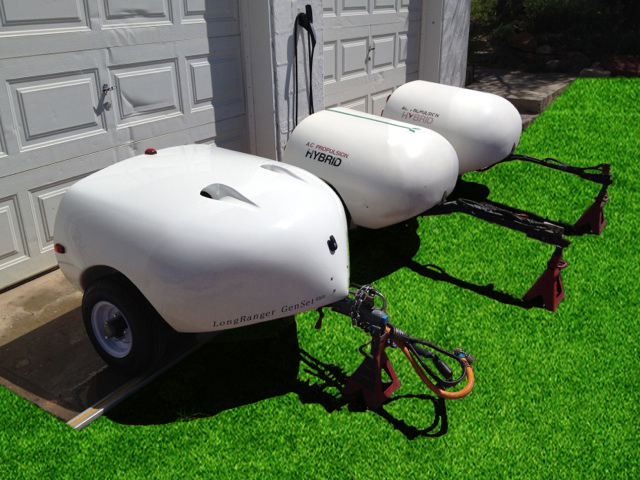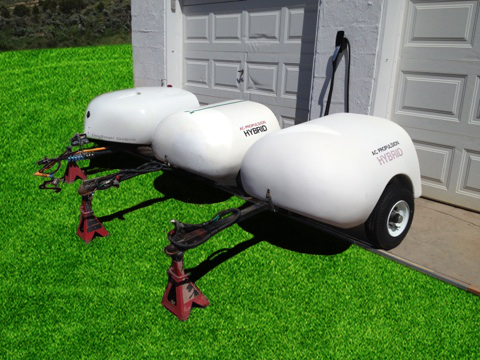

Description
Designed by AC Propulsion & Alan Cocconi

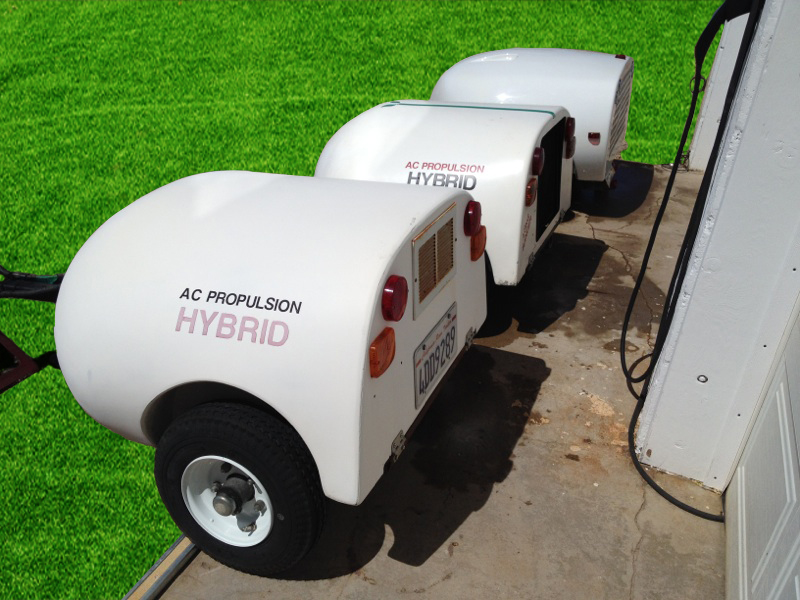
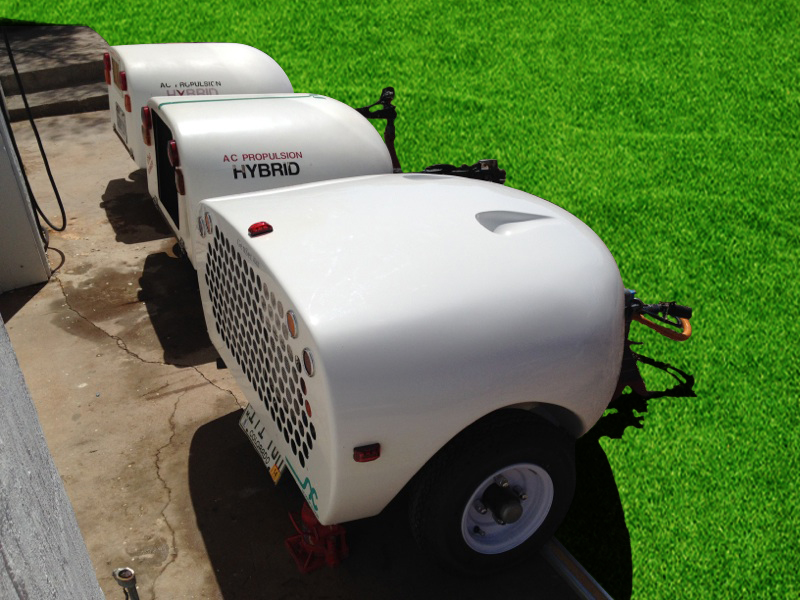
RXT-G stands for Range Extending Trailer - Generator and
have also been referred to as:

" LongRanger,"
" Range Extender," or
" GenSet "  trailers.

These units convert BEVs (Battery Electric Vehicles) into 'series' hybrid vehicles
for long distance & cross country travel.

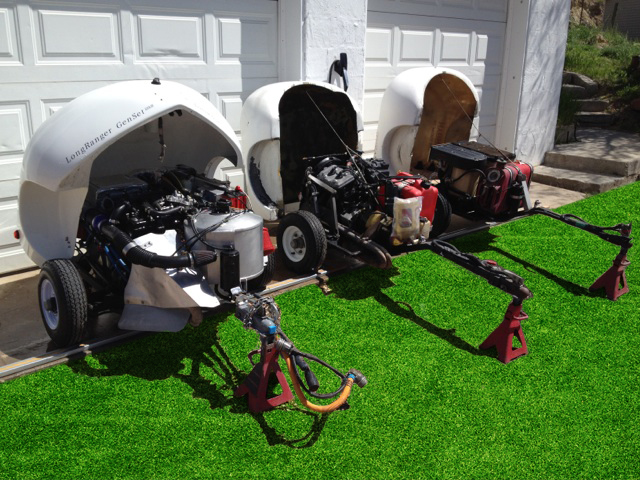
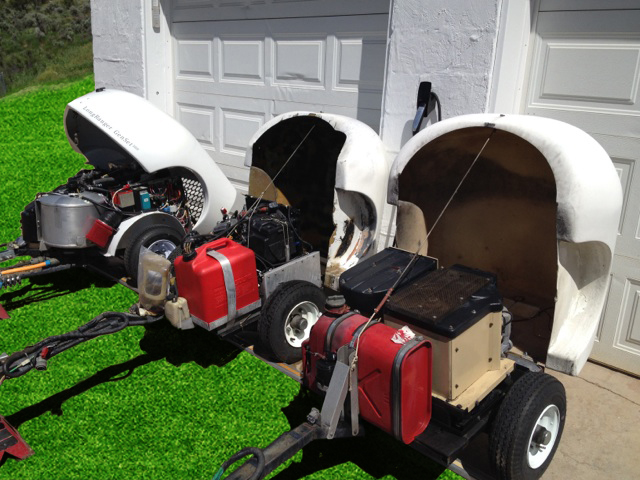
AC Propulsion's LongRanger development includes three prototype
versions built between 1992 & 2001 for various applications.  The Beata Collection
includes one of each development model as referenced below.  All of
the examples are operational
and representative of range extending technologies of the day.

The three models include:

The LongRanger I (9kW) - [c1992]
utilized an air cooled B&S ICE.  We understand that several
examples of this version are in existence.

The LongRanger II (17kW) - [c1994]
utilized  a 250cc water cooled ICE.  This unit was a one-off
prototype.

The LongRanger III (20kW) - [c1998 - 2001]
utilized a 500cc water cooled ICE of which there are three
known examples.  The Beata Collection holds the last
of the LongRanger III units, the TMC
commissioned  prototype for the production NiMH Rav4-EV.

Owning to the BEVs "electric first" design, 'series' hybrids are capable of greater
overall range when compared to early development standard OEM
'parallel' hybrid drives; which, by definition, relyed on "ICE first" with only
an electric boost to primaty ICE operations.  In recent years, c2017, OEM hybrids
have begun developing a dual system that allows slower speeds to
be pure electric, cancelling ideling, and initiating ICE operations after a given range.
As development continues hopefully OEMs will pursue pure BEV drives as
a primary focus, and smaller and more
efficient 'series' ICE drives (meant only to support zero SOC situations)
as a secondary focus.

Additional Wikipedia data at:
http://en.wikipedia.org/wiki/Genset_trailer
===

We recently learned (c2022) that GM EV1 engineers had built a 'hand-full' of
range-extending series generator trailers at the Milford Proving
Grounds facility during the 1990s.  With the lead-acid
batteries of the day equaling a 100/mile/charge vehicle, and engineers tasked
with 60,000 mile durability test regimes, the series generator trailers
were needed to solve the issue of putting a lot of miles on a
low range vehicle.  We would love to see some pictures, or locate an
old example, of the GM range extenders.

rxt-g (at) tzev (dot) com

'92 - '95 - '01 BEV RXT-Gs
- RXT-G = Range Extending Trailer - Generator
- LongRanger --
- Range Extender --
- GenSet --
BEV hybrid drive development and testing - 9kW, 16kW & 20kW units